Showing posts with label Indiana. Show all posts

Wednesday, January 26, 2022

Indiana - Mitchell

Garden - Pioneer Village, Spring Mill State Park

The mill near Mitchell, Indiana was built in the early 1800s because of the plentiful amount of water that came from a cave at the site. In 1825 Hugh and John Hamer of Albany, New York purchased the mill. Under the administration of Hugh Hamer various stores were opened in the village.  The garden looks as the garden would have looked when the Hamer family was there. The economy of the village began to decline when railroads brought competition to the area. By the late 1880s the mill was no longer in operation.

The mill has been preserved in the present day Spring Mill State Park. 
Gus Grissom was from Michell, Indiana. 
The Donaldson woods in the state park have had and have old growth trees in the forest.

Friday, August 31, 2018

We Can Take It


Lodge - Starved Rock State Park, Illinois

The CCC built  rustic shelters in the woods in various locations in  rural America.
The CCC was perhaps the most popular of the New Deal programs brought out to stem the suffering of the Depression.   The legacy of the New Deal construction may be seen in Kentucky and in the Southeast.

The Levi Jackson State Park near Corbin, Kentucky rests on the alignment of the Wilderness Road. The Wilderness Road was key to the early settlement of the Kentucky area.  The CCC provided much of the roads and the parking areas at the park. 
The Pine Mountain State Park, was established in 1924, in Bell County Kentucky.   The CCC played an active role in constructing the Pine Mountain State Park.  The CCC provided the design and construction of a gatehouse in the rustic style.  The CCC completed a custodian’s house, service buildings, a ranger station, a water reservoir and pump house, roads, campgrounds, and parking areas.

The CCC consciously designed the Laurel Cove Amphitheater and grounds for the Pine Mountain State Park to be in harmony with the natural cove of the forest at that site.   The buildings and structures were blended into the natural landscape.  The enrollees built an amphitheater, stage, and reflecting pool. 

If the Laurel Cove Amphitheater is the crowning achievement of the CCC at the Pine Mountain Park, the Arch Bridge on Upper Park Road is a close second accomplishment.   The stone bridge is essentially hand made.  This bridge is one the region’s beautiful stone bridges.  This bridge spans a sixty two foot gap between two hills in the park road system.     

Part of the basis for the CCC was that the Corps gave unemployed people work to do.  Many young people had been in situations of impoverishment and malnourishment.  In addition some provision was made for older men who were out of work World War I veterans.   The CCC provided nourishing food and more for its enrollees.  The CCC provided essential education of reading and writing for enrollees that needed this basic schooling.  More advanced schooling was available for those enrollees that could handle the coursework.  The CCC slogan was “We can take it.”   The enrollees showed that they could do more than it was believed that they could do.

The CCC enrollees had a big task set before them.   Woodlots and pastures in the East had been ruined from years of timbering without proper control of erosion.  Great areas of land could be bought for almost nothing after the destruction of the natural features of the landscapes.   The CCC planted and built to try to foster the redemption of the damaged lands.  The sense of the CCC work to restore the natural functioning of the countryside was borne out over the succeeding decades.
The lodge at De Soto State Park in Alabama was built by the CCC.  The building has since been remodeled to be used for a kitchen and restaurant. 

The CCC enrollees left quite a record in Indiana.  The CCC built in Brown County State Park, Clifty Falls State Park, Salamonie Lake State Forest, Spring Mill State Park, and Turkey Run State Park.  The village area at Spring Mill State Park is largely a product of CCC construction. 

The CCC built the lodge at Starved Rock State Park in Illinois and a contractor built the wing with the guest rooms adjoining the lodge.   The huge timbers at the lodge at Starved Rock are a model of the craftsmanship done by the CCC.

“We can take it.” The CCC has been popular because of the organization’s record of accomplishment.  Sometimes the work of someone benefits others long after the original work. People do better when they work together.   Better together;  sounds like an idea for making things better.

Wednesday, September 13, 2017

On the river


Braided Rug - Scribner House, New Albany, IN
The Scribner house is located in New Albany, Indiana near the water side of the Ohio River.  The first man to build and maintain the house was Joel Scribner. Then the son, William, Dr. William Scribner lived there.  Then the daughter Hatie lived there.  She sold the house to the Daughters of the American Revolution.  The house is under the care of the Daughters of the American Revolution.  Only Scribner family members have lived in the house.  For the Bicentennial of the house a book about the house was generated.  Ann Caudill coauthored the book.

Thursday, June 22, 2017

Louisville, Kentucky - New Albany, Indiana


The railroad along the Ohio River

The railroad in New Albany, Indiana carries long trains.  One can see trains just down the slope from State and Main streets.

Thursday, January 21, 2016

Bridging Louisville and Jeffersonville

Lincoln Bridge to Indiana


Newly installed cable for Lincoln Cable Stayed Bridge

The new Ohio River Bridge between Kentucky and Indiana was opened on December 6, 2015 for people to see safely while walking on the bridge.  The bridge is a cable stayed bridge. It has been a long time getting to this point.  The Walsh company is providing the bridge.  The staff of Walsh must feel good to see the bridge coming together.

Friday, October 16, 2015

The great array that is available to us

Wild turkeys - Clifty Falls, Indiana
If one has a sense of wonder one finds one is a part of nature.  When you are mindful, you are present, you feel that you want to say "Oh!"  We have senses that allow us to feel the beauty of nature, and to absorb the beauty of nature into us.

Thursday, October 15, 2015

A great day - gratitude

Cake Rock - Clifty Falls, Indiana
We care about the things we love.  When one comes to this place one loves this place.
We want to protect these things.  The light of imagination comes into our being and we say "Oh!"

Friday, September 11, 2015

The destruction of the wild


Toppled giant, Spring Mill, Indiana


The great wilds of our country once held to be boundless and inexhaustible are being rapidly invaded and overrun in every direction, and everything destructible in them is
being destroyed. How far destruction may go is not easy to guess. Every
landscape low and high seems doomed to be trampled and harried.

John Muir

The cause of the fall of the giant tree at Spring Mill is unknown.  The great clearing of wild places without regard to the cost is plain to see in the Midwest.  If you see much of the Midwest or the Southeast in this country you see the great loss
of habitat in this country.

Tuesday, September 8, 2015

Ohio River Bridge - Big Four Bridge


The Big Four Railroad Bridge at night

The former Big Four railroad bridge has been renovated so that people may ascend to the bridge and walk over the Ohio River.  Lighting has been added to the bridge so that a rainbow of colors may be seen at night.  A controller can command the lights on the sides of the bridge to display a purple color or most any color.  The people in  community use the bridge to walk up to the bridge level and view the river from the bridge.  Ohio River bridges must meet a eighty foot height standard so that boats may pass under the bridge decks.  People sometimes walk down the ramps and buy ice cream from the neighborhood sellers in Jeffersonville.   All this walking and moving is good exercise.  Since the air quality in the area has improved doing strenuous outside activities is not as dangerous as it once was.

Thursday, August 27, 2015

Hammer's Cave Spring and Spring Mill Inn


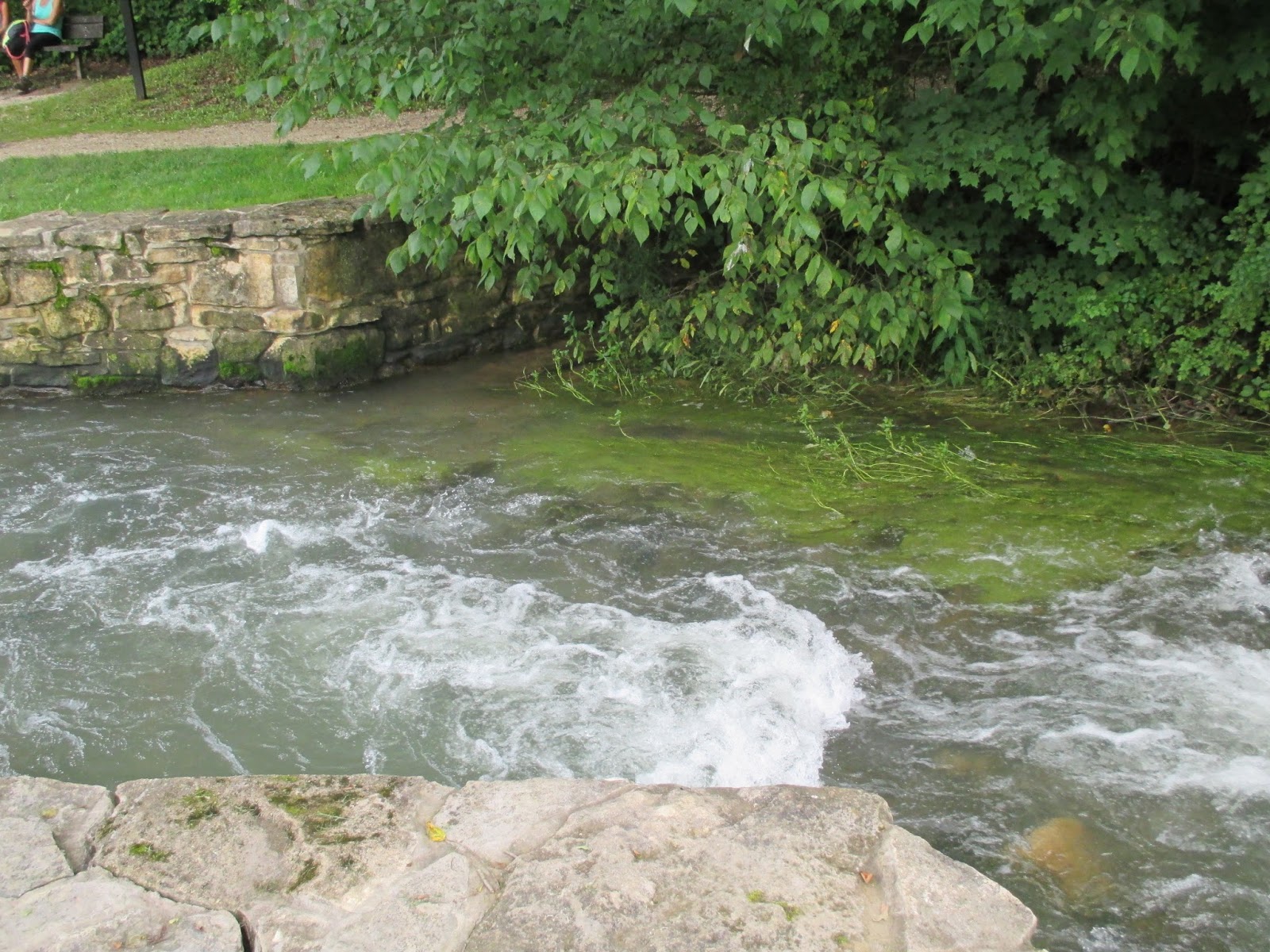
The water from Hammer's Cave Spring at Spring Mill

The restaurant at Spring Mill Inn near Mitchel, Indiana is a popular place for good food.  I had heard that a desert made from the fruit of the persimmon tree was available for patrons.  I looked for it but I did not find it.  I asked if the persimmon tree dessert was available for me.  Yes! I had it and the only drawback is I think the preparer is adding sugar to the fruit.  Nonetheless it is a treat to enjoy.

The forest area around the inn is very healthy.  It is possible and I hope it is true that the persimmon fruit desserts at Spring Mill Inn are local food.

Monday, August 10, 2015

Hammer's Cave Spring


Many people speak of Indiana as the Crossroads of America. The  days of life in the nineteenth century in Indiana are the subject of the historic area at Spring Mill near Mitchel, Indiana.  Samuel Jackson, Jr. had served in the Navy in the War of 1812.  He moved to the area now preserved at Spring Mill in 1814.  In 1817 the Bullitt brothers of Louisville bought the land and began to add structures to the community.  It was the Bullitt brothers that built the three story stone mill.  In 1824 another set of brothers purchased the property.  This time it was the Montgomery brothers of  Philadelphia.  They built a distillery at the site.  In 1833 the Hammer brothers purchased the mill.  The source of the water for the mill is called Hammer's cave.  The tall cedar trees on the lawn have been dated to be older than the time of the Hammer era.  One can touch the same trees that the Hammer children played under in their lives at this beautiful place.

This is a colorful place; those who come may take a wonderful memory with them.

Saturday, May 30, 2015

Cliffs and places - Indiana

Massive Rock - Rocky Hollow Falls Canyon, Indiana


The Turkey Run area has cool shady areas such as the Rocky Hollow Falls Canyon where rare plants may grow.  The ravines have been sculpted by the running water making unusual shapes in the rock faces.

Monday, May 11, 2015

What I saw - Bridge over Sugar Creek, Indiana


The red siding is the side of the covered bridge.  The bridge abutment is
fashioned from Mansfield sandstone.

A stream in the area near Crawfordsville, Indiana is called Turkey Run.  But a much broader area than the immediate area of the stream is known as Turkey Run.

Layers of sand at the bottom of the sea were compressed to become sandstone.  This is the local   Mansfield sandstone.
There is a metal plaque on the door of the house where John Lusk lived. The house is near the Narrows point in Sugar Creek.  The 1883 covered bridge crosses the creek here at the Narrows. The plaque reads “To the memory of John Lusk who saved the trees of Turkey Run.”  The plaque is labeled “The Nature Study Club of Indiana.”

What better thing can be said of a person than he "saved the trees."  In so many cases irreplaceable trees have been lost.  Thanks to John Lusk the trees of Turkey Run are living to this day.

"These forests were composed of about five hundred species of trees, all of them in some way useful to man, ranging in size from twenty-five feet in height and less than one foot in diameter at the ground to four hundred feet in height and more than twenty feet in diameter,—lordly monarchs proclaiming the gospel of beauty like apostles. For many a century after the ice-ploughs were melted, nature fed them and dressed them every day; working like a man, a loving, devoted, painstaking gardener; fingering every leaf and flower and mossy furrowed bole; bending, trimming, modeling, balancing, painting them with the loveliest colors; bringing over them now clouds with cooling shadows and showers, now sunshine; fanning them with gentle winds and rustling their leaves; exercising them in every fibre with storms, and pruning them; loading them with flowers and fruit, loading them with snow, and ever making them more beautiful as the years rolled by. Wide-branching oak and elm in endless variety, walnut and maple, chestnut and beech, ilex and locust, touching limb to limb, spread a leafy translucent canopy along the coast of the Atlantic over the wrinkled folds and ridges of the Alleghanies,—a green billowy sea in summer, golden and purple in autumn, pearly gray like a steadfast frozen mist of interlacing branches and sprays in leafless, restful winter."  John Muir

What I saw - Indiana scenic places


Wedge Rock - This huge rock fell into the ravine from the top of the ravine. The
 trees give help with the size of the rock and the time that the rock has been
resting at its current location.

Punch Bowl - This place shows the work of the erosion of the rock


In Western Indiana the Sugar Creek area near Crawfordsville was once under a sea.  Layers of sand at the bottom of the sea were compressed to become sandstone.  This is now named the Mansfield sandstone. The coal that is found in the area was laid down during the time that the sea was gone but marshes covered the area.  After that time the area was covered with ice.  Rock brought with the ice is called glacial drift.  This material lodged in waterways and changed the flow of surface water.
New surface water streams developed in the area.  The stream that that is now known as Sugar Creek changed the look of the area. Sugar Creek and its tributaries eroded into the Mansfield sandstone.  In places the deep ravine is wider than the upper reaches of the ravine.  The eroded canyons have dramatic shapes.  The cool shady areas provide habitat for rare plants.

When one walks in a Northerly direction the path comes an area of bare rock that looks something like a sloped stack of oatmeal cookies.  A cascade of water noisily falls down this stack of rocks.  The wet rock surfaces are slippery.  After climbing that sloped area the sides of the ravine narrow until one finds almost no places to step without stepping into the high velocity water rushing toward the walker.

A dramatic passageway that goes on for dozens of feet must be negotiated with the churning water constantly flowing through the sandstone.  It is possible to make it through without stepping into the rushing water but it takes some doing.

It is a place of becoming very close to the rock cliff faces.


Sunday, November 9, 2014

What I saw - Brown County State Park

Land in Brown County, Indiana began to be purchased for a public park in the 1920s.   Originally  the purpose was stated to be for a wildlife preserve because that was the only  purpose sanctioned in Indiana state law. The site opened as a park in 1929. In 1934 the CCC began working to reclaim the land from the damage of heavy erosion. The CCC built trails and planted trees.  The spruce trees in the park were planted by the CCC.


North Overlook vista - The North Overlook Shelter was provided by the CCC


Strahl Lake


Ogle Lake - Built by the CCC


In addition the CCC built the lake known as Ogle Lake at the park.  The park gets much use but it has a beauty and an appeal that is not dampened by the volume of visitors.  There is a spirit among those who come.  The people just seem to make it work and share the park.